




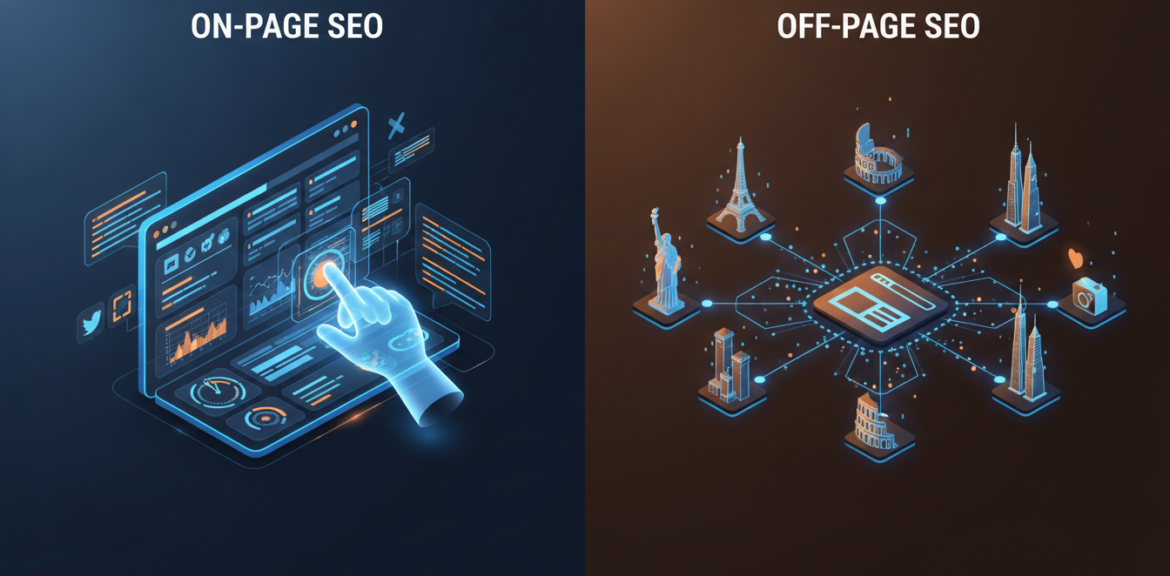

Let’s be real for a second: SEO can feel like trying to solve a Rubik’s Cube that changes colors every time you blink. Just when you think you’ve nailed the algorithm, Google throws a curveball. But amidst all the AI overviews and core updates, two things remain the absolute bedrock of your strategy: On-Page and Off-Page SEO.
Think of your website like a car. On-Page SEO is everything under the hood and inside the cabin—the engine, the leather seats, the dashboard. It’s what you have total control over. Off-Page SEO? That’s your street cred. It’s what other people say about your car, the awards it wins, and whether cool people want to be seen driving it. You can build the fastest Ferrari in the world (On-Page), but if nobody talks about it or trusts it, it’s just going to sit in the garage.
In this guide, we’re cutting through the noise to break down exactly what differs between these two giants and, more importantly, how to balance them to survive the SEO landscape of 2026.
The Control Centera: Mastering On-Page SEO
On-Page SEO is your home turf. It’s every single tweak, edit, and optimization you make directly on your website. In 2026, this isn’t just about stuffing keywords into meta tags; it’s about crafting an experience that keeps users glued to the screen.
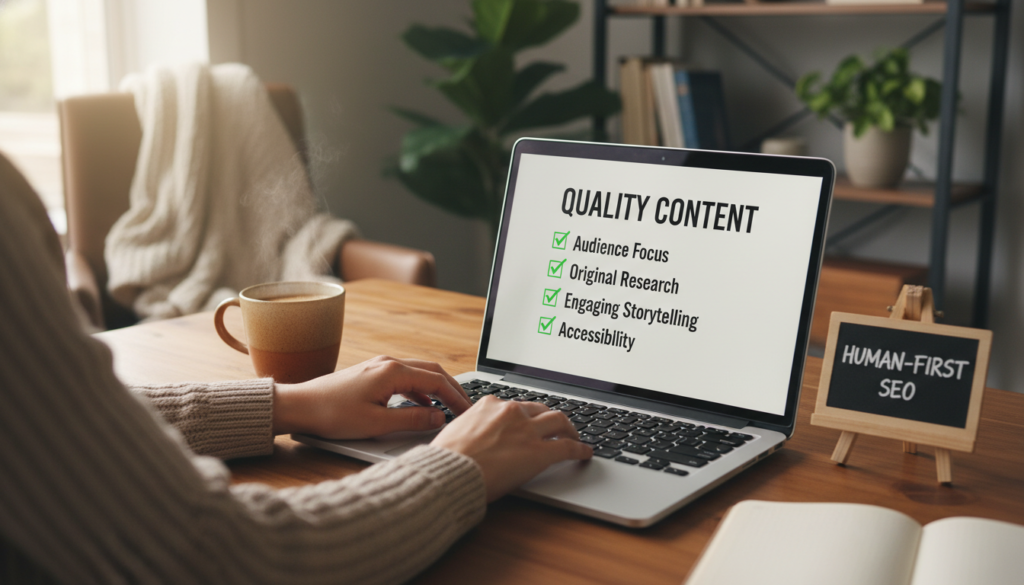
First up is content quality. Gone are the days of writing for robots. With Google’s “Helpful Content” system fully integrated, your articles need to demonstrate genuine E-E-A-T (Experience, Expertise, Authoritativeness, and Trust). If you’re writing about “best hiking boots,” you better sound like you’ve actually climbed a mountain, not just summarized an Amazon product page.
Then there’s the technical side of On-Page (often called Technical SEO, though they are close cousins). This includes your site speed, mobile-friendliness, and internal linking structure. If your site takes ten seconds to load, users are bouncing faster than a superball, and Google notices. In fact, Core Web Vitals are now a critical part of the puzzle, measuring visual stability and interactivity. Essentially, On-Page SEO is about making your site understandable to search engines and delightful for humans.
The Reputation Game: Winning at Off-Page SEO
If On-Page SEO is what you say about yourself, Off-Page SEO is what the world says about you. It’s the popularity contest of the internet. Historically, this has been synonymous with backlinks—links from other sites pointing to yours. And let’s be clear: backlinks are still a top ranking factor. A link from a giant like the New York Times or a niche authority is like a powerful vote of confidence that tells Google, “Hey, this content is legit.”
But here is the plot twist for 2026: it’s not just about links anymore. Off-Page SEO has evolved into Digital PR and brand entity building. Google is getting smarter at recognizing brand mentions even if they aren’t hyperlinked. If people are talking about your brand on social media, forums, and review sites, that contributes to your “Topic Authority.”
Also, don’t ignore Local SEO signals if you have a physical presence. Managing your Google Business Profile and getting consistent NAP (Name, Address, Phone) citations are huge Off-Page signals that validate your existence in the real world. It’s all about building a footprint that proves you aren’t just a fly-by-night AI content farm.
The Quality vs. Quantity Debate in 2026
Here is where many DIY marketers get tripped up. Ten years ago, you could blast your site with thousands of low-quality directory links and watch your rankings soar. Try that today, and you’ll get slapped with a penalty faster than you can say “spam.”
The new golden rule is Quality > Quantity. A recent study of over 1,000 websites confirmed that link relevance and authority carry far more weight than raw numbers. One link from a highly relevant industry blog is worth more than 100 links from random, unrelated sites.
This applies to On-Page content too. Google’s algorithms are aggressively filtering out “scaled content”—basic, repetitive articles clearly written just to capture search traffic. The focus has shifted to content depth and user engagement. If users land on your page and immediately leave (pogo-sticking), it tells Google your On-Page SEO failed to deliver, no matter how many backlinks you have.
The Symbiotic Relationship: Why You Can’t Choose Just One
Asking “Which is better: On-Page or Off-Page?” is like asking if breathing in is more important than breathing out. You literally need both to survive.
Imagine you have amazing Off-Page SEO. You’ve been featured in Forbes, influencers love you, and your domain authority is sky-high. But, your On-Page SEO is a disaster—slow loading times, broken links, and thin content. When all that referral traffic arrives, they’re going to have a terrible experience and leave. You’ve wasted your reputation.
Conversely, you could have the most beautifully optimized On-Page experience with Shakespearean-level content. But without Off-Page signals (backlinks and promotion), Google’s crawlers might never find you in the vast ocean of the internet. As industry experts note, content needs backlinks to rank, but backlinks need quality content to stick. They feed into each other in a continuous loop of authority and relevance.
Technical SEO: The Engine Room
Before we wrap up, we have to give a nod to the unsung hero: Technical SEO. While often grouped under “On-Page,” it really deserves its own category. This is the plumbing of your website. It involves XML sitemaps, canonical tags, and schema markup.
Think of it this way: On-Page is the decoration, Off-Page is the marketing, and Technical SEO is the foundation. If your foundation is cracked (e.g., Google can’t crawl your site because of a robots.txt error), no amount of blogging or link building will save you. In 2026, with the rise of AI-driven search, having structured data (Schema) that helps machines understand your content is becoming non-negotiable.
Conclusion
So, where should you spend your energy? The answer is a balanced diet of both. Start with your On-Page SEO—it’s the low-hanging fruit. Polish your content, fix your technical errors, and ensure your user experience is buttery smooth. Once your house is in order, invite the neighbors over with a robust Off-Page strategy. Focus on building genuine relationships, earning high-quality links, and growing your brand’s digital footprint.
SEO isn’t a one-time setup; it’s a marathon. But by understanding the distinct roles of On-Page and Off-Page optimization, you’re already miles ahead of the competition. Now, go forth and rank!